Session 1: Rush hour
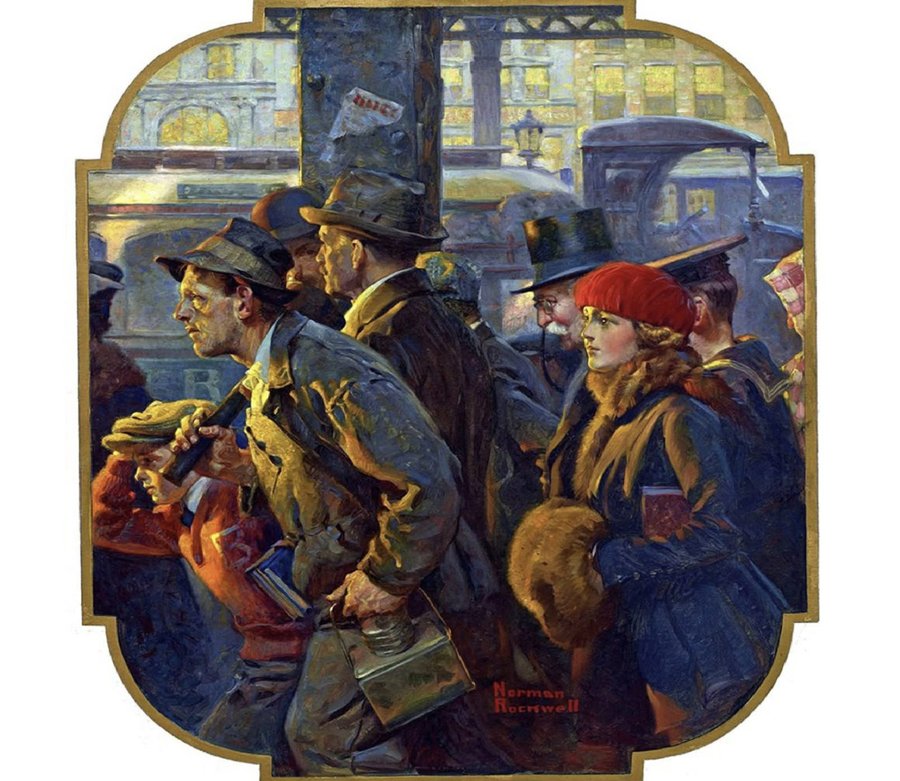
- Name four ways to travel to school.
- What is the English word for « le métro » in London? And in New York?
- What time do you leave home in the morning?
Answer key
- For example: by bus, by train, by car, by bike, on foot, by scooter.
- In London: the Tube or the Underground. In New York: the subway.
- Personal answer: I leave home at seven fifteen / at a quarter past seven.
In this session, you need to describe the painting: who the people are, where they are, what they are doing, what time it is and how they feel.
To say what is happening in the picture, we use the present continuous: The worker is carrying a lunch pail. To place people, we need prepositions of place: in the foreground, on the left, under the railway. To give an impression, we use look + adjective: He looks tired.
Norman Rockwell (1894 to 1978) was an American painter and illustrator. He painted 323 covers for The Saturday Evening Post alone, and many more for other magazines. This painting was the cover of The Literary Digest, a weekly American magazine, on 6 November 1920. Its title is End of the Working Day; it is also called Commuter Rush. The Norman Rockwell Museum explains that it shows New Yorkers walking under the trestle of an elevated train (the « L ») during rush hour, with a trolley car in the background.
Building your vocabulary
| Word | Meaning | Example |
|---|---|---|
| a commuter | a person who travels between home and work every day | The commuters are walking fast. |
| rush hour | the busy time when people go to work or come home | It is rush hour in New York. |
| a crowd | a lot of people together | The crowd is moving to the right. |
| an elevated railway (the « L ») | a railway on a high metal structure above the street | They are walking under the elevated railway. |
| a trolley car / a streetcar | an old electric tram on rails in the street | There is a trolley car in the background. |
| a lunch pail | a metal box for a worker's lunch | The worker is holding a lunch pail. |
| a cap / a beret / a top hat | three kinds of hats | The young woman is wearing a red beret. |
| a fur muff | a tube of fur to keep your hands warm | She has a big fur muff. |
| a sailor | a person who works on a ship | A sailor is walking behind her. |
| in the foreground / in the background | at the front / at the back of the picture | The worker is in the foreground. |
| to hurry | to move fast because you have little time | Everybody is hurrying home. |
| tired / relieved / determined / worried | four feelings | He looks tired but determined. |
- Present continuous: what is happening in the picture
- be + verb + -ing. The boy is carrying books. The people are walking home. The woman isn't smiling.
- Question form
- What is the worker holding? Where are they going?
- there is / there are
- There is a trolley car in the background. There are lights in the windows.
- Prepositions of place
- in the foreground, in the background, on the left, on the right, in the middle, behind, next to, in front of, under, above
- look + adjective / look like + noun
- He looks tired. She looks like a student.
Quick check. Correct the mistake: The worker carry a lunch pail in the picture.
Answer key
The worker is carrying a lunch pail. (present continuous: be + verb-ing)Exercises
1. Who is who?Entryrecognition
Match the person and the description.
- the worker
- the schoolboy
- the young woman
- the old gentleman
- the sailor
a. He is wearing a top hat and glasses. · b. She is wearing a red beret and holding a fur muff. · c. He is wearing a uniform with a large sailor collar. · d. He is carrying a lunch pail and a tool. · e. He is wearing a cap and carrying books.
Answer key
1d, 2e, 3b, 4a, 5c
2. Where are they?Entryguided
Complete with: in the foreground, in the background, on the left, on the right, under, behind.
- The worker is ... of the painting, in front of the others.
- The young woman in the red beret is ... .
- The trolley car is ... .
- Everybody is walking ... the elevated railway.
- The sailor is ... the young woman.
- The schoolboy is ..., next to the worker.
Answer key
- in the foreground
- on the right
- in the background
- under
- behind
- on the left
3. What are they doing?Entryguided
Put the verb in the present continuous.
- The worker (carry) ... a lunch pail.
- The young woman (hold) ... a book under her arm.
- The schoolboy (hurry) ... .
- The people (walk) ... to the right.
- The old man (look) ... down.
- The sun (shine) ... on their faces.
Answer key
- is carrying
- is holding
- is hurrying
- are walking
- is looking
- is shining
4. Questions and answersCoreguided
Write the question, then answer it.
- What / the worker / hold?
- Where / the people / go?
- What / the young woman / wear?
- Who / walk / next to the worker?
- Why / everybody / hurry?
Answer key
- What is the worker holding? He is holding a lunch pail and a tool.
- Where are the people going? They are going home.
- What is the young woman wearing? She is wearing a red beret and a coat with a fur collar.
- Who is walking next to the worker? A schoolboy is walking next to him.
- Why is everybody hurrying? Because it is the end of the working day and they want to get home.
5. Morning or evening?Corereasoning
Find three clues in the painting and the title. Then complete: I think it is the ... because ...
Answer key
Clues: the windows of the buildings are lit; the light is low and golden, like a sunset; the title is End of the Working Day. I think it is the evening because the windows are lit and the title says it is the end of the working day.
6. How do they feel?Coreguided
Choose an adjective and justify with because: tired, determined, relieved, serious, calm, cold.
- The worker looks ... because ...
- The young woman looks ... because ...
- The old gentleman looks ... because ...
Answer key
Possible answers: 1. The worker looks tired but determined because his face is thin and he is walking fast. 2. The young woman looks calm and serious because she is not smiling and she is looking straight ahead. 3. The old gentleman looks serious because he is looking down.
7. Odd one outEntryvocabulary
- cap, beret, top hat, lunch pail
- commuter, crowd, sailor, railway
- tired, relieved, foreground, worried
- train, trolley car, subway, sunset
Answer key
- lunch pail (not a hat)
- railway (not a person)
- foreground (not a feeling)
- sunset (not a means of transport)
8. Describe the paintingCoreyour own production
In pairs, describe the painting in one minute each. Use: This is a painting by... / It shows... / In the foreground... / There is... / He is... -ing / She looks... Your partner checks one thing: did you use the present continuous five times?
Answer key
Model: This is a painting by Norman Rockwell from 1920. It shows a crowd of commuters in New York at rush hour. In the foreground, a worker is carrying a lunch pail. On the right, a young woman in a red beret is holding a book. They are walking under an elevated railway. They look tired but they are hurrying home.
Make deductions: It must be the evening because the windows are lit. The young woman might be a student or an office worker. The man in the top hat can't be a factory worker: he is too elegant. Write a museum label of about 70 words: artist, title, date, what we see, and the message of the painting.
Model label
Norman Rockwell, End of the Working Day, 1920. At sunset, a crowd of New Yorkers is hurrying home under the elevated railway. A worker with his lunch pail walks next to a schoolboy and a young woman in a red beret. Rich and poor, young and old share the same street. Rockwell shows the tiredness of the day, but also the relief of going home.
- Learn the twelve words of the table.
- Describe a photo of your own journey to school (bus stop, station, street) in five sentences in the present continuous. No faces, please.