Dys version
Dys version
Rush Hour: Getting to Work. The same eight sessions, in short steps. One step at a time. Important words are in bold. Click to see the answers.
Readable font, large spacing, no italics. Your teacher can read the documents aloud, and the videos have subtitles.
Session 1. Rush hour
What is the English word for « le métro » in London?
Answer
The Tube.
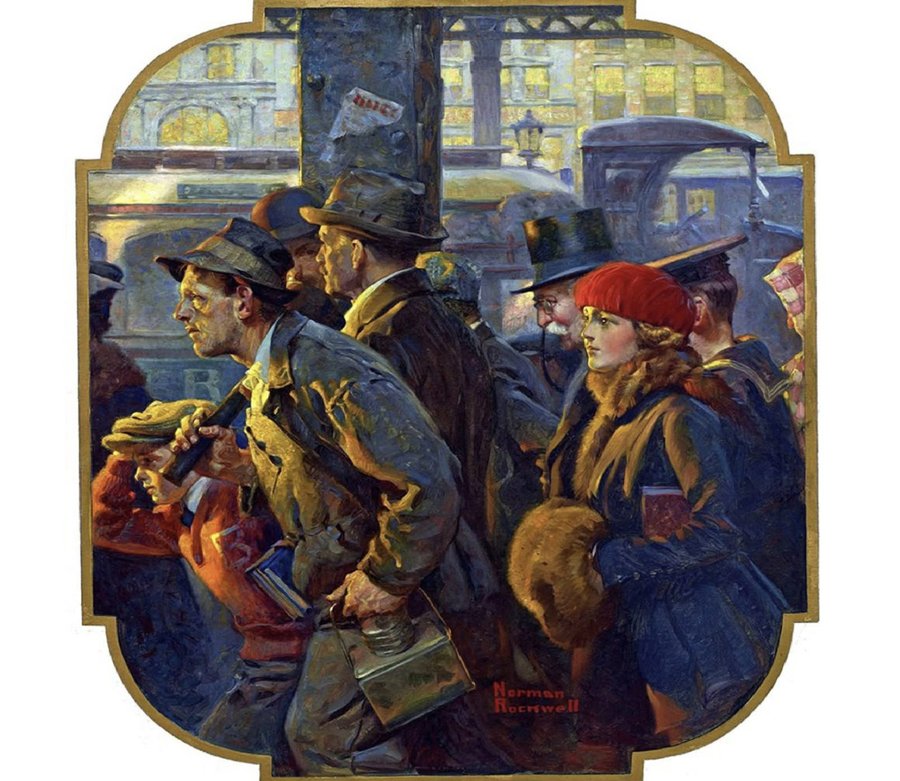
Describe the painting: who, where, what time, how they feel.
Example: The worker is carrying a lunch pail. He looks tired.
Present continuous = be + verb-ing: he is walking, they are walking. In the foreground = at the front.
Complete: The young woman ... (wear) a red beret.
Answer
is wearing
Where is the trolley car: in the foreground or in the background?
Answer
In the background.
Morning or evening? Find one clue.
Answer
Evening: the windows are lit, and the title is End of the Working Day.
Learn six words of the painting.
Session 2. How do you get to school?
Say one thing you can see in Rockwell's painting.
Answer
For example: a worker with a lunch pail.
Say how you travel, how often and how long it takes.
Example: I usually take the bus. It takes me twenty minutes.
always, usually, often, sometimes, never: before the verb. It takes me + time + to + verb.
Put the word in the right place: I take the bus. (usually)
Answer
I usually take the bus.
by or on? I go to school ... foot.
Answer
on
Ask the question: It takes me ten minutes.
Answer
How long does it take you?
Time your journey to school and write one sentence: It takes me...
Session 3. London and New York
Complete: It takes ... twenty minutes to get to school.
Answer
It takes me twenty minutes.
Compare the Tube in London and the subway in New York.
Example: The Tube opened in 1863, whereas the subway opened in 1904.
both... and... = the two. whereas = but, to show a difference.
UK or US: the subway?
Answer
US. In the UK: the Tube.
How much is one subway ride in New York?
Answer
$3.00 (three dollars).
Join with whereas: London has zones. New York has one price.
Answer
London has zones, whereas New York has one price.
Learn three pairs: Tube / subway, queue / line, timetable / schedule.
Session 4. Delays and problems
Give the American word for the Tube.
Answer
The subway.
Understand an announcement, say sorry, give a reason.
Example: I'm sorry I'm late. My train was delayed due to a signal failure.
because + sentence: because the bus was late. because of / due to + noun: due to a strike.
What does « Please mind the gap » mean?
Answer
Be careful of the space between the train and the platform.
because or because of? I'm late ... the traffic.
Answer
because of
Make it polite: When is the next train?
Answer
Could you tell me when the next train is, please?
Learn three ways to say sorry.
Session 5. Green commuting
Complete: The train is late ... a strike.
Answer
due to / because of
Give your opinion on the car, the bike, car-sharing, working from home.
Example: I think cycling is good because it doesn't pollute.
If + present, will + verb: If more people cycle, there will be less traffic.
Complete: If it ... (rain), I will take the bus.
Answer
rains
In France in 2017, how many workers in 100 went to work by car?
Answer
74 (INSEE).
Agree or disagree: Everybody should cycle. Give one reason.
Answer
For example: I don't agree, because some people live far away.
Write two sentences with If...
Session 6. The cost of commuting
Complete: If more people cycle, there ... (be) less traffic.
Answer
will be
Read prices and figures, and compare them.
Example: A monthly Travelcard is more expensive than a weekly cap.
Short words: cheap, cheaper than, the cheapest. Long words: expensive, more expensive than, the most expensive.
Say aloud: £8.90
Answer
eight pounds ninety
Complete: The annual Travelcard is (cheap) ... twelve monthly Travelcards.
Answer
cheaper than
How long was the average one-way trip to work in the US in 2024?
Answer
27.2 minutes (US Census Bureau).
Learn how to say five prices.
Session 7. My future job
Say aloud: $35.
Answer
thirty-five dollars
Talk about working hours and plan your journey to your work placement.
Example: I'm going to take the 7.10 bus. I have to start at 8.
have to = necessary. don't have to = not necessary. mustn't = forbidden. going to = my plan.
mustn't or don't have to? At 17, you ... work at night.
Answer
mustn't
at, on or in? I start ... 8 o'clock.
Answer
at
Write your plan: leave home / 7.00 (going to)
Answer
I'm going to leave home at 7.00.
Write your journey plan in three sentences.
Session 8. Final task
Complete: I ... (have to) wear safety shoes.
Answer
have to
Present your ideal commute, or write an email to your tutor to explain a delay.
Example: My ideal commute would take twenty minutes by bike. / I'm afraid I will be late because...
Email: Subject, Dear..., sorry, reason, time of arrival, solution, Thank you, Best regards.
Put in order: Dear Mr Collins / Best regards / I'm afraid I will be late.
Answer
Dear Mr Collins, I'm afraid I will be late. Best regards.
Give one argument for your ideal commute.
Answer
For example: it's faster and cheaper than the car.
Self-assessment: three things I can say now.