Rush Hour: Getting to Work
Introduction
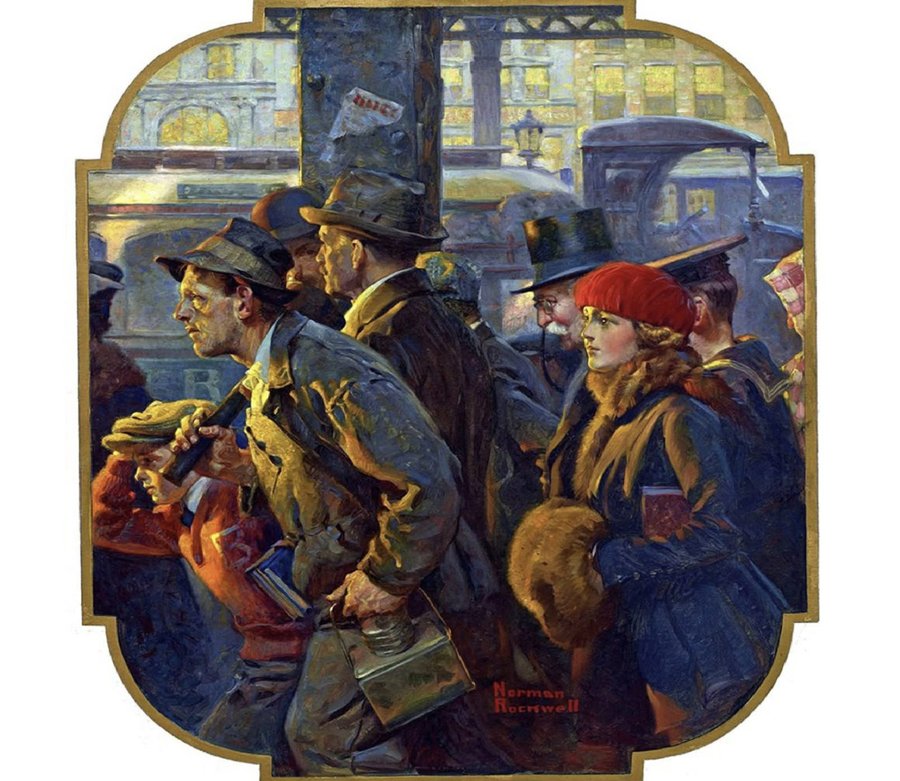
Why this sequence? Every morning and every evening, millions of people travel between home and work: this is commuting. In 1920, Norman Rockwell painted a crowd of New Yorkers at the end of the working day, under an elevated railway. A hundred years later, you will soon make the same journey to your work placement and to your first job. This sequence helps you talk about it in English.
Key question. How do people get to work, and what makes a good commute?
Levels. Bac pro, 2de, 1re and Tle, all pathways. Three tiers in every session: Entry guided B1, Core B1+, Stretch B2.
Organisation. Eight sessions of 55 minutes. Each session opens with a recap, starts from what you need to say, then the Point prof (grammar), many exercises from recognition to your own production, a Stretch section and Homework. Answer keys are hidden until you click.
Final task. Present your ideal commute in two minutes, or write an email to your work placement tutor to explain a delay (session 8).
Also available. A dys version of every session and a sources page. Every fact and figure comes from an official source: Transport for London, the New York MTA, the US Census Bureau, INSEE, Île-de-France Mobilités and Service Public.
Overview
| Session | Key question | Language |
|---|---|---|
| 1. Rush hour | Who are these people, and where are they going? | Present continuous, there is / there are, prepositions of place, look + adjective |
| 2. How do you get to school or work? | How do we travel every day, and how long does it take? | Adverbs of frequency, How often? How long does it take? It takes me... |
| 3. Commuting in London and New York | How do Londoners and New Yorkers get to work? | British and American English, comparing: both, whereas, unlike |
| 4. Delays and problems | What do you say when things go wrong on the way? | Apologising, polite complaints, because / because of / due to |
| 5. Green commuting | Is there a better way to get to work? | Giving opinions and arguing, first conditional |
| 6. The cost of commuting | How much time and money do we spend on the way to work? | Comparatives and superlatives, big numbers and prices |
| 7. Commuting and my future job | How will I get to my work placement, and when will I work? | have to / don't have to / mustn't, will and going to, time prepositions |
| 8. Final task | Can you present your ideal commute or explain a delay by email? | Review of the sequence and assessment |